Post 9: Alike or Different
Post 9: Alike or Different
Personal Objective:
Common Core Standard:
K.G.B. Analyze, compare, create, and compose shapes.
K.G.B.4. Analyze and compare two- and three-dimensional shapes, in different sizes and orientations, using informal language to describe their similarities, differences, parts (e.g., number of sides and vertices/“corners”) and other attributes (e.g., having sides of equal length).
Activity:

Task:
In pairs:
1. Students take turns drawing two cards.
2. They should name something that is the ALIKE or DIFFERENT between the two cards.
(ex: “This one is curvy and this one isn’t”; “This one has more corners”; “Both of them are pointy”).
3.The next two cards are drawn and the process repeats until no cards remain.
Corporately:
1.The students work together to name a property for each pair.
2. The student who can name a property first gets to keep the cards and the student with the most cards at the end of the game wins.
(ex: “This one is curvy and this one isn’t”; “This one has more corners”; “Both of them are pointy”).
Note: Since the properties may depend on the orientation of the cards, students should sit side-by-side if working cooperatively. If a more difficult game is desired the students can name two things that are alike or different.
Attached Resources:
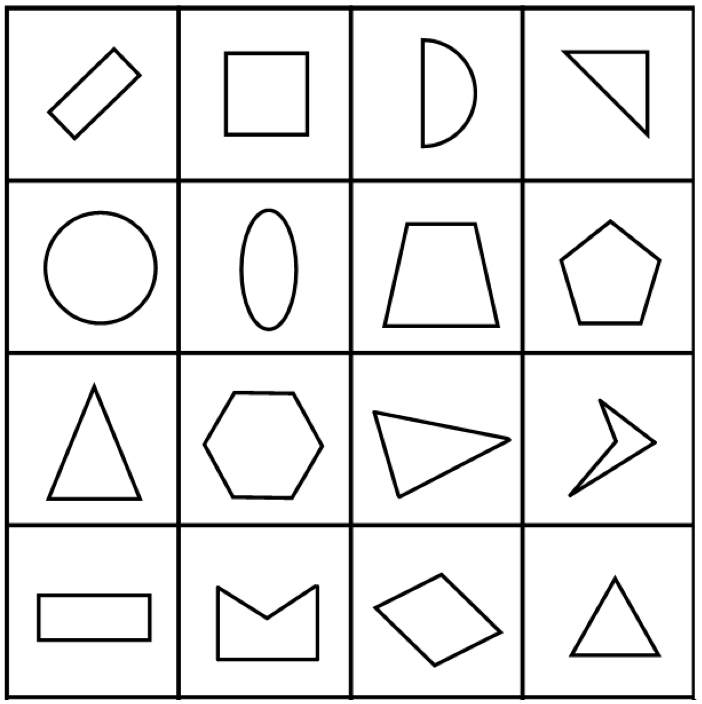


Reflection:
I picked this task because, "this particular task is linked very intentionally to the first part of Mathematical Practice Standard 3, construct viable arguments. Students work in pairs and take turns drawing two cards. These cards have pictures of different shapes. The students are asked to describe what is similar or different between the two shapes. This type of task lays the foundation for the art of explanation leading to “critiquing the reasoning of others.” Before students can critique the reasoning of others, they must feel comfortable in supporting their own thinking with evidence. For instance, a kindergartner might offer the explanation, “I know that the shape has straight sides and the second shape has one curvy.” The teacher can easily promote a classroom discussion on this argument by asking, “Do you agree and why?” This type of math talk in the classroom is built through collaborative problem solving and dialog." I have been finding that there will be many times in which this will occur and yet I have learned after this blog that the focus must remain on one. Teaching in general over all based on the standards have their own vocabulary and context that I must expose myself to in order to understand and be a phenomenal educator.
Submitted to Jason Dyer to the fourth Illustrative Mathematics task writing contest.

This game of alike and different is such a good way to get students to start to think critically, not only do they have to know the shapes but to see what is alike and different about them, to start to compare and contrast objects.
ReplyDeleteI love this activity, Ana! This is so incredibly useful and constructed in such a well thought out way to incorporate real discussion amongst the students. I think this is very valuable and I will definitely remember this for when I am in a classroom. Thank you for sharing!
ReplyDelete